Why E-commerce Stores Fail in 2026: Hidden Loss Factors You Must Know
 Nafeesa Parveen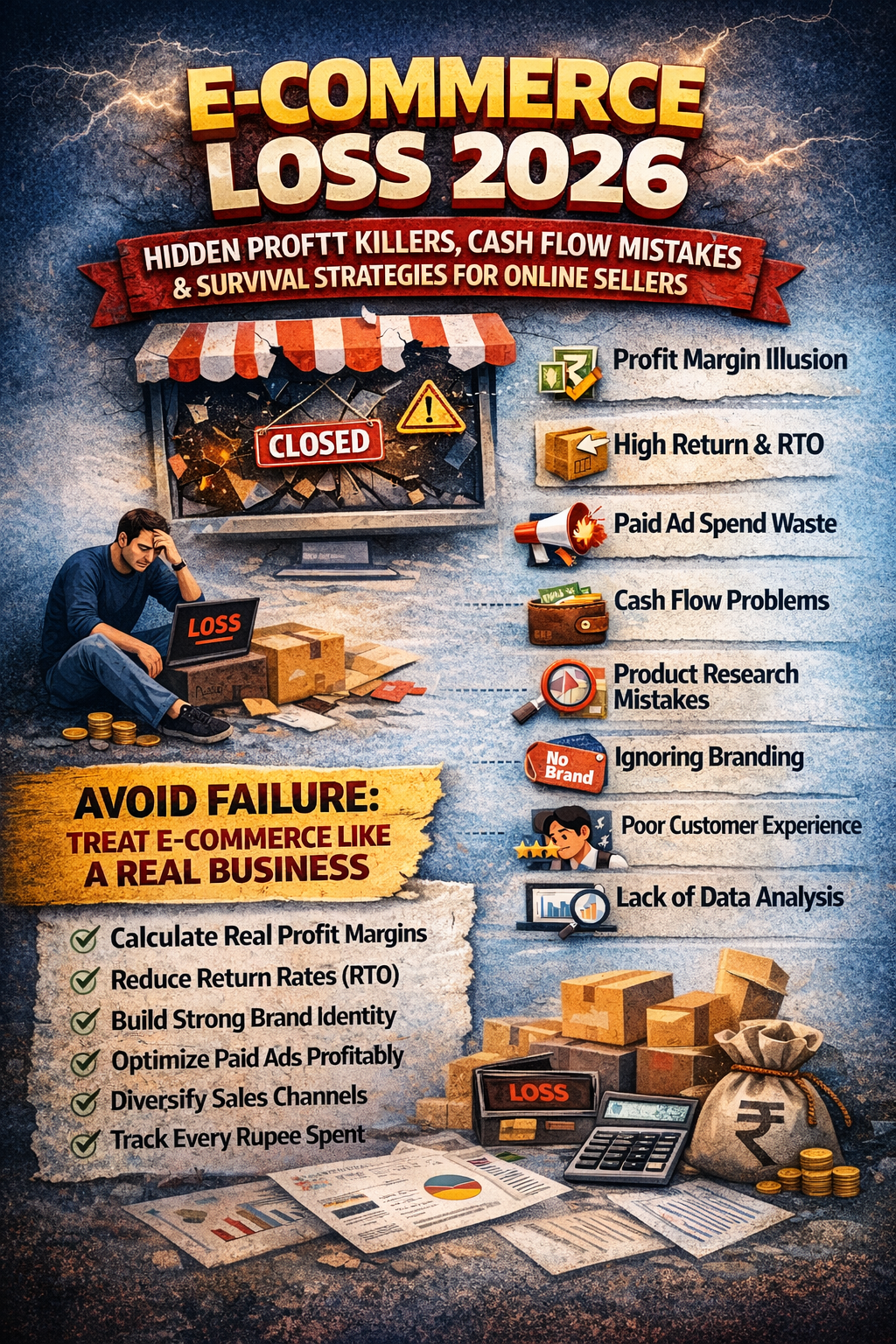
Discover the real reasons behind E-commerce Loss 2026 and learn how online sellers are losing money due to hidden costs and poor strategy.
E-commerce Loss 2026
E-commerce is growing rapidly in 2026. More sellers are joining marketplaces like Amazon, Flipkart, Meesho, and building independent stores using Shopify. On social media, online business looks glamorous — screenshots of high sales, viral products, success stories everywhere.
But behind the scenes, there is another reality:
Thousands of e-commerce sellers are facing heavy losses.
The shocking part?
Most of these losses are not visible at first.

This article will deeply explain:
- Why e-commerce loss in 2026 is increasing
- The hidden cost factors killing profit
- Common beginner mistakes
- Advanced financial miscalculations
- Real survival strategies
If you are an online seller — or planning to become one — this guide can save you from major financial damage.
Chapter 1: Understanding the Concept of E-commerce Loss 2026
E-commerce loss does not always mean negative bank balance.
There are three types of losses sellers experience:
1. Direct Financial Loss
When total expenses exceed total revenue.
2. Hidden Margin Loss
When profit is too small to sustain growth.
3. Opportunity Loss
When poor decisions block long-term success.
In 2026, competition has become more professional. Sellers using data, automation, and branding are surviving. Casual sellers chasing trends are struggling.
Chapter 2: The Profit Margin Illusion
Most beginners calculate profit like this:
Selling Price – Product Cost = Profit
But real calculation includes:
- Platform commission
- Shipping charges
- Return shipping
- Payment gateway fees
- GST
- Packaging cost
- Advertising cost
- Discounts
- Warehousing charges
Example:
Selling Price: ₹1,000
Product Cost: ₹500
Looks like ₹500 profit.
But actual:
Commission (15%): ₹150
Shipping: ₹80
Return reserve: ₹100
Ads cost per order: ₹120
GST impact: ₹50
Packaging: ₹20
Real Profit: ₹-20 (Loss)
This is one of the biggest reasons behind E-commerce Loss 2026.
Chapter 3: High Return & RTO – The Silent Killer
Return to Origin (RTO) is destroying profit margins.
Reasons:
- Fake COD orders
- Customer impulsive buying
- Poor product description
- Delivery refusal
- Address issues
If RTO rate crosses 20%, business becomes unstable.
Each RTO means:
- Forward shipping loss
- Reverse shipping loss
- Packaging damage
- Inventory blocking
Solutions:
- COD confirmation calls
- SMS verification
- Partial prepaid orders
- Clear product visuals
- Targeted pin code control
ChatGPT Tutorial 2026
Artificial Intelligence has transformed how we work, create content, run businesses, and learn new skills. In 2026, tools like OpenAI’s ChatGPT have become essential for entrepreneurs, students, freelancers, marketers, and business owners.
Chapter 4: Ad Spend Burn Without Strategy
Advertising in 2026 is expensive.
Common mistakes:
- Boosting posts randomly
- No audience testing
- No conversion tracking
- Emotional scaling
If Customer Acquisition Cost (CAC) is higher than profit margin, you lose money on every order.
Example:
Profit per order: ₹200
Ad cost per order: ₹250
You are losing ₹50 per order while thinking sales are growing.
Smart sellers:
- Test creatives
- Analyze conversion rate
- Scale only profitable campaigns
- Kill poor ads fast
Chapter 5: Cash Flow Mismanagement
Even profitable stores collapse due to cash flow issues.
Why?
- Marketplace payment delay
Discover the real reasons behind E-commerce Loss 2026 and learn how online sellers are losing money due to hidden costs and poor strategy. - High inventory investment
- Ad payments upfront
- Seasonal sales drops
Profit on paper ≠ Cash in hand.
Cash flow management rules:
- Keep 3–6 months reserve
- Avoid overstocking
- Track weekly cash movement
- Separate business & personal money
Chapter 6: Inventory Mistakes
Two dangerous extremes:
- Overstocking
- Understocking
Overstocking blocks capital.
Understocking reduces ranking and momentum.
Smart strategy:
- Use small batch testing
- Track stock turnover ratio
- Forecast demand seasonally
- Avoid emotional bulk buying
Chapter 7: No Branding Strategy
In 2026, branding is survival.
Customers trust brands, not random sellers.
Without branding:
- No repeat customers
- No price control
- High dependency on ads
- Low loyalty
Brand building includes:
- Consistent packaging
- Logo identity
- Social proof
- Email marketing
- Customer relationship building
Brand reduces long-term E-commerce Loss.
Chapter 8: Poor Customer Experience
Bad experience leads to:
- Negative reviews
- Higher return rate
- Lower conversion
- Account risk
Common mistakes:
- Late dispatch
- Poor packaging
- No customer support
- Complicated return policy
Customer satisfaction reduces refund rates and increases repeat orders.
Chapter 9: Ignoring Data & Analytics
Successful sellers track:
- Conversion rate
- CAC (Customer Acquisition Cost)
- AOV (Average Order Value)
- LTV (Lifetime Value)
- Refund %
- RTO %
Failing sellers operate blindly.
Data-driven decisions reduce risk dramatically.
Chapter 10: Platform Dependency Risk
Relying on only one marketplace is dangerous.
Account suspension
Policy change
Commission increase
Algorithm update
Your business can stop overnight.
Diversify:
- Marketplace
- Own website
- Social media
- WhatsApp marketing
- Email list building
Chapter 11: Legal & Compliance Mistakes
Ignoring:
- GST filing
- Proper invoicing
- Trademark
- Product compliance
Can freeze payouts or block accounts.
Compliance is boring but necessary.
Chapter 12: Unrealistic Expectations
Many people enter e-commerce expecting:
- Quick money
- Passive income
- Viral success
Reality:
- Testing phase
- Loss phase
- Optimization phase
- Scaling phase
Patience is mandatory.
Chapter 13: Advanced Hidden Costs in 2026
New hidden factors:
- AI-based ad competition
- Rising logistics charges
- Higher customer expectations
- Platform penalty fees
- Data privacy compliance
Margins are shrinking globally.
Only optimized sellers survive.
Chapter 14: Survival Blueprint for 2026
Step 1: Calculate real net margin
Step 2: Keep RTO under 15%
Step 3: Optimize ads weekly
Step 4: Build brand identity
Step 5: Improve packaging
Step 6: Focus on retention marketing
Step 7: Track cash flow strictly
Step 8: Diversify platforms
Chapter 15: Long-Term Strategy vs Short-Term Trend
Short-term sellers chase trends.
Long-term sellers build systems.
Systems include:
- Supplier relationships
- Data dashboards
- Retargeting campaigns
- Repeat purchase funnels
Long-term thinking prevents E-commerce Loss 2026.
Final Conclusion
E-commerce Loss 2026 is not happening because online business is dead.
It is happening because:
- Sellers ignore hidden costs
- Profit is miscalculated
- Branding is ignored
- Data is not tracked
- Cash flow is mismanaged
If you treat e-commerce like a serious business —
analyze numbers, control expenses, build brand, manage cash —
You can not only avoid loss
but build a sustainable, scalable business.
About the Author